The Songs You Didn't Play: What Every Gap in a Setlist Is Really Saying
The List Before the List
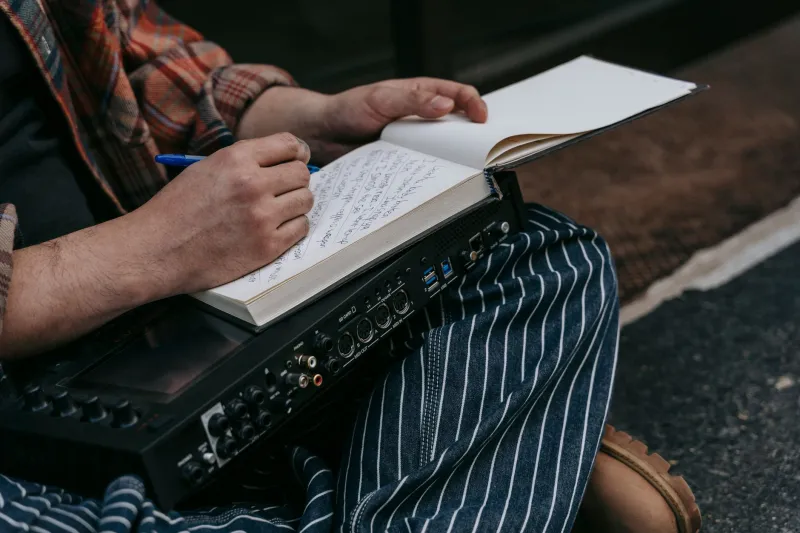
Before any show, there's a moment — usually alone, usually with a cup of something hot going cold on the table — where you sit with a blank piece of paper and decide what version of yourself you're going to be tonight. Not consciously. Not like you're building a persona or crafting a brand. More like... you feel your way toward it. Some songs come forward immediately. Others hang back. And some you don't even write down, not because you forgot them, but because you already know.
That knowing is where the real story lives.
We talk a lot about what artists choose to share — the bold move, the vulnerable lyric, the unexpected cover that signals something new. But the conversation that doesn't happen nearly enough is about the deliberate absences. The songs that sit on the shelf. The stories edited down to a punchline. The collaborations declined without public explanation. These omissions aren't gaps in the portrait. They are the portrait.
What Gets Left Off and Why
I've played enough rooms — small ones, loud ones, rooms that smelled like whatever the previous act had been — to know that what I decide not to play on any given night is rarely random. Sometimes a song belongs to a version of me I've moved past, and dragging it out would feel like wearing a costume. Sometimes a song is still too close, too raw, too much like handing someone a live wire and hoping they're careful with it.
And sometimes — and this is the one people don't expect — a song gets left off because the audience has already decided what it means, and their meaning has drifted so far from mine that playing it feels like a lie.
That last one is the complicated one. Because audiences don't mean any harm. They love what they love. But love can be possessive, even when it's completely sincere. When a song becomes a sing-along, it stops being yours in a very specific way. That's not always a bad thing. But sometimes you need to protect the original feeling of something, and the only way to do that is to keep it off the list.
The Audience Fills in the Blanks
Here's what's interesting about intentional omissions: people notice. Maybe not everyone, but the ones who've been paying close attention — the ones who know your catalog better than you do on a tired Tuesday — they notice. And when they notice, they speculate.
Social media has made this into a whole sport. Someone doesn't play a song they used to play, and within hours there's a thread. She's distancing herself from that era. He must have had a falling out with whoever wrote that bridge. They probably can't perform it live anymore without the original lineup. Sometimes the speculation is right. Sometimes it's wildly, almost impressively wrong.
What strikes me is how rarely anyone considers the simplest explanation: maybe it just doesn't fit who they are right now. Maybe they're protecting it. Maybe the song is still alive somewhere private, and putting it on a stage would kill something about it.
The audience's need to fill in the blank says as much about them as the blank itself says about the artist. We're all trying to complete the picture. But some parts of the picture are deliberately unfinished — and that incompleteness is the point.
The Collaborations You Didn't Take
This goes beyond setlists, honestly. The same logic applies to every creative decision that involves saying no. The collaboration you turned down. The project that looked like a natural fit but felt wrong in your chest when you imagined doing it. The interview request from the publication that would have been great exposure but wanted you to frame your story in a way that didn't quite fit.
Every one of those no's is a brushstroke. The people who know you well enough can see the shape of who you are partly by what you consistently refuse. Not because refusal is noble — it isn't, automatically — but because what you protect tells you something about what you actually value.
I've said no to things that looked, from the outside, like obvious yes's. And I've had to sit with the discomfort of knowing that some people read those no's as fear, or preciousness, or some kind of artistic ego. Maybe sometimes they were right. But mostly, they were no's because the thing being offered didn't match the thing I was trying to make. And protecting that alignment — even when it costs you visibility, even when it costs you relationships — is part of the work.
Learning to Trust Your Own Editing
The culture we live in rewards output. More songs, more posts, more content, more presence. The idea that withholding something could be a creative act, that restraint could be a form of expression, runs against pretty much everything the internet tells us about how to build an audience.
But every great setlist is also an act of editing. The songs that make the cut aren't just the ones that sound good tonight — they're the ones that form a coherent emotional arc when placed in sequence. The ones left off aren't necessarily weaker. They might just disrupt the story you're trying to tell in this particular room, to this particular crowd, on this particular night.
Trusting your own editing is hard. It requires believing that the shape of what you've made — including its silences — is worth defending. That the blank spaces aren't failures of courage or productivity. That sometimes the most honest thing you can offer an audience is the shape of what you chose not to give them.
The Portrait in the Negative Space
Art history has a concept — negative space — where the empty areas around a subject are as compositionally important as the subject itself. The space that isn't the thing defines the thing. It gives it weight, proportion, meaning.
I think about that a lot. The songs I didn't play. The stories I kept. The invitations I declined. The version of myself I didn't put on the poster. All of that negative space is part of the self-portrait too. Maybe the most honest part.
Next time you're at a show — mine or anyone else's — and you find yourself wondering why they didn't play that one song, sit with the question for a minute before you reach for your phone to complain about it. The answer might be more interesting than the song itself.