Going Dark Was the Best Thing I Ever Did for My Art
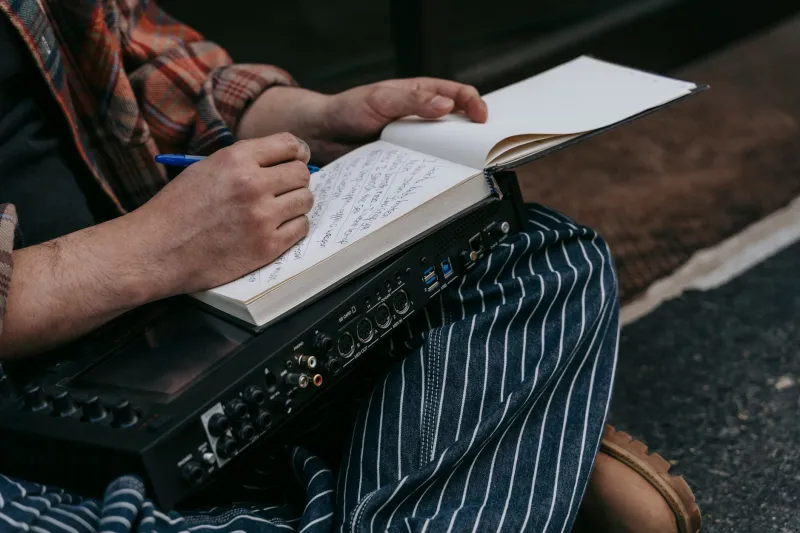
Somewhere between a sold-out night and a Tuesday afternoon with zero notifications, I made the best song I'd written in years. Nobody asked for it. Nobody knew I was working on it. The only person in the room was me, a cup of coffee going cold on the windowsill, and whatever weird, half-formed thing was trying to climb out of my chest.
That's not a romantic accident. That's a pattern I've watched repeat itself across decades of making things — my own things, and the work of people I've known and admired. The moments of genuine creative honesty almost never happen under a spotlight. They happen in the dark, when the pressure to perform for an audience has temporarily lifted and something truer gets to come through.
We don't talk about this enough. Especially now, when the whole ecosystem of making art has been reorganized around visibility — around the feed, the post, the engagement number ticking up or down like a verdict.
The Weight You Don't Notice You're Carrying
When you've had any kind of audience — even a small, devoted one — you start writing for them before you even pick up the instrument. It's not a conscious choice. It's more like a gravitational pull. You remember what they responded to. You feel, somewhere in the back of your brain, the ghost of their approval or disappointment. And so you start self-editing before the idea is even fully formed.
I'm not saying audiences are bad. Lord knows I love mine. But there's a version of you that only exists when no one's expecting anything, and that version has access to material the performing version never will.
Psychologists call it evaluation apprehension — the way our behavior changes when we know we're being observed. Athletes experience it. Comedians talk about it. And for artists, it's not just about nerves. It's about the slow, invisible way that sustained observation reshapes what we're willing to try. You stop experimenting. You stop failing productively. You start managing.
What Obscurity Actually Offers
I've been lucky enough to experience both ends of the attention spectrum over the years, and I'll tell you something that sounds counterintuitive: the periods of lower visibility were often the most generative. Not because suffering is romantic or struggle is noble — I'm not interested in that mythology. But because obscurity removes a specific kind of pressure that recognition quietly installs.
When nobody's watching, you're allowed to be bad at something new. You can write a song that goes nowhere and feel nothing but curious about why. You can change directions without it reading as a betrayal of whoever thought they knew what you were about.
There's a real creative privilege in being forgotten, even temporarily. It gives you back the authorship of your own process.
I've talked to musicians who had genuine cultural moments — songs that landed, tours that mattered — and almost universally, the work they're most proud of came either before the recognition hit or in the quiet stretch that followed. The sweet spot, if you can call it that, is the space between being discovered and being defined.
Optimizing for Visibility Is Its Own Kind of Trap
Here's what the current content machine asks of artists: be consistent, be present, be legible. Show your process. Document your inspiration. Make your creative life into content that can be consumed in thirty-second increments. And look — I understand the pragmatic argument. You have to eat. Audiences don't wait forever. Platforms reward regularity.
But when every moment of your creative life is potentially a post, something shifts. The unfinished thing, the weird experiment, the idea that might be embarrassing — all of it gets filtered through the question of whether it's shareable. And that filter, applied early enough and often enough, starts to change what you're willing to begin in the first place.
The most dangerous thing about optimizing for visibility isn't that it makes bad art. It's that it makes competent art. Polished, audience-aware, reliably pleasant art that never quite surprises anyone, including you.
How to Protect the Dark
I'm not suggesting you disappear. I'm suggesting you build in protected space — literal and psychological — where the work doesn't have to perform.
For me, that's meant keeping certain projects entirely off social media until they're finished. Not teasing them, not workshopping them in public, not inviting feedback before the thing has had a chance to become what it actually wants to be. It's meant taking stretches of time — sometimes just a few days, sometimes longer — where I'm not tracking who's listening or what's getting attention.
It's also meant getting honest about the difference between connection and surveillance. Sharing your work with people you trust is connection. Broadcasting every step of your process to maximize engagement is something else entirely, and conflating the two is a trap that's particularly easy to fall into when you're an artist who genuinely loves your audience.
Your most honest audience might be the one that doesn't exist yet — the future listener who'll encounter the work without any of your explanatory scaffolding around it. Making for that person requires a willingness to disappear from the present moment's attention economy, at least for a little while.
The Song the Room Doesn't Know About
There's a song I've been working on that nobody knows about. Not because it's precious or secret, but because it's still figuring out what it is, and the minute I start talking about it, I'll start shaping it toward the talking instead of toward the truth.
That's the privilege of invisibility. Not the absence of an audience, but the temporary suspension of their gaze — long enough for you to remember what you were actually trying to say before everyone started listening.