Ghost at the Door: What Happens When Your Past Self Shows Up Uninvited
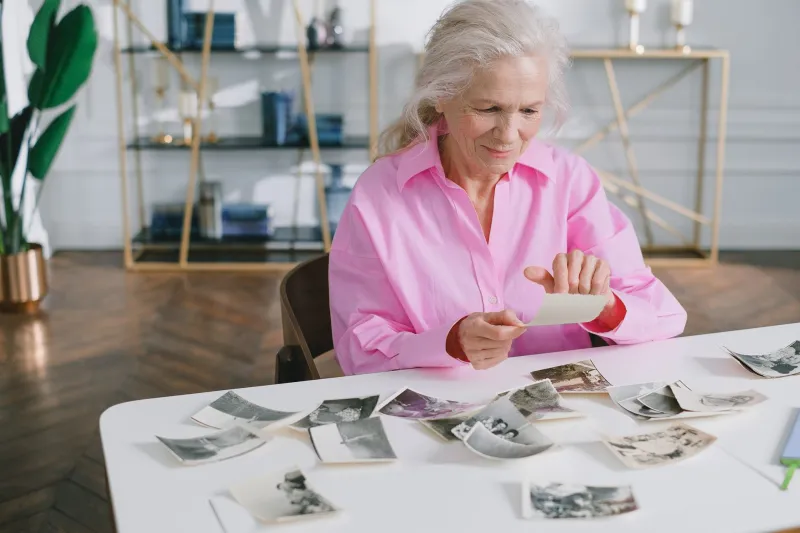
It started with an email. Three sentences, a name I hadn't thought about in years, and a subject line that read: Just checking in. I sat there staring at my laptop screen for a solid minute before I even clicked it open. Because I already knew — the way you just know these things — that whatever was inside that message was going to cost me something.
Not money. Not time. Something harder to replace: the comfortable distance I'd built between the person I am now and the person I was then.
This is the thing nobody warns you about when you commit to a creative life over the long haul. It's not the blank page that undoes you. It's the reunion nobody scheduled.
The Ambush of Familiarity
Reconnecting with your past doesn't always arrive as a dramatic confrontation. Sometimes it's quiet. A former collaborator slides into your inbox. A local venue you played twenty years ago reaches out about a booking. You're cleaning out a storage unit and you find a cassette tape — actual cassette tape — of demos you recorded in someone's living room when you were twenty-three and completely certain you were about to change everything.
And suddenly you're not standing in a storage unit anymore. You're back there. You can practically smell the cigarette smoke and cheap coffee.
That disorientation is real and it deserves to be taken seriously. It's not weakness. It's not sentimentality. It's your nervous system trying to reconcile two very different versions of yourself occupying the same moment in time.
I've learned to sit with that feeling instead of rushing past it. Because there's information in it, if you're willing to listen.
What the Old Work Actually Says
A few years back, I stumbled across some writing I'd abandoned — a project I'd started and quietly shelved after convincing myself it wasn't good enough. Reading it again with fresh eyes was genuinely disorienting. Parts of it were rough, sure. But parts of it were alive in a way that caught me off guard.
There was a fearlessness in those pages. A willingness to be messy and direct and a little embarrassing. The kind of creative honesty that's easy to lose once you've had enough people watching you that you start second-guessing every instinct.
Reconnecting with old work can do one of two things. It can light a fire under you — remind you of an instinct you've been suppressing, a thread worth picking back up. Or it can confirm, quietly and without drama, that you have genuinely moved on. That the version of you who made that thing was doing their best with what they had, and that's enough. You don't owe that old self a resurrection.
Both outcomes are valid. The trick is figuring out which one is actually happening, instead of defaulting to either uncritical nostalgia or reflexive dismissal.
The Complicated Math of Old Collaborators
People are trickier than old cassette tapes. Because people have feelings, and history, and their own version of events that may not line up with yours at all.
When an old creative partner reaches back out, there's always a negotiation happening beneath the surface of the conversation. Who were we to each other? Who are we now? Is this person reaching out because something genuine is pulling them back, or because they're stuck and hoping I can be part of the solution?
I don't say that cynically. I've been on both sides of that equation. There are people from my past I've reached out to because I genuinely missed the creative electricity we had. And there are times I've reached out because I was struggling and their name felt like a life raft.
Honesty about the motivation matters. Because if you go into a reunion collaboration carrying unexamined nostalgia, you're not actually working with the person standing in front of you. You're working with a ghost. And ghosts make lousy creative partners.
Returning to a Place That Remembers You Differently
There's a specific flavor of this experience that happens when you go back to a physical place — a venue, a neighborhood, a city — that knew you when. The room might look almost exactly the same. The stage might even be the same dimensions. But you are not the same person who stood on it before, and the gap between those two versions of you can feel enormous.
I played a small venue in the Northeast a while back that I'd performed at decades earlier. The owner still remembered me. A few people in the audience had seen me there the first time around. And I had this strange double vision all night — aware of who they thought they were coming to see, and aware of who I actually was now.
It could have been paralyzing. Instead, I made a decision to let both things be true at once. I honored the history without being imprisoned by it. I played some older material because it meant something to the people in that room, and I played newer work because it meant something to me. That negotiation — between what was and what is — is one of the most honest things a performer can do.
Protecting Where You're Going
Here's what I've figured out, after enough of these unexpected reunions: the past has a gravitational pull that can masquerade as inspiration.
Sometimes going back really does reignite something real. A forgotten idea turns out to be ahead of its time. A lapsed collaboration turns out to have legs you couldn't see before. An old venue turns into a full-circle moment that feeds your creative soul for months afterward.
But sometimes — and this is the part that requires honesty — the pull toward the past is actually avoidance. It's easier to revisit something familiar than to push forward into the uncertainty of new work. It's easier to re-examine an old relationship than to do the harder thing of building something from scratch.
The question worth asking, every single time one of these reunions lands on your doorstep, is simple: Does this take me toward who I'm becoming, or does it keep me tethered to who I was?
You're allowed to say no to the email. You're allowed to leave the cassette tape in the box. You're allowed to play the old venue and feel the nostalgia without letting it redirect your entire trajectory.
And you're equally allowed to say yes — fully, openly, without apology — when the reunion is actually a gift.
The past isn't the enemy. But it doesn't get to be the boss, either. You've come too far for that.